To the Land of Milk and Honey: My visit to the Holy Land

 Part One. Mount of the Ascension


To start this off, I should first let you know that this probably not going to be the funniest post I’ve ever written, but I hope that you’ll enjoy this sharing of experience nonetheless.  This was not the first time I’ve ever been to the Holy Land. I went once when I was twelve, and once with my family four years ago. It’s hard to count my trip back in my childhood, seeing as all I really got from it was a vague feeling of boredom and an unbridled anger at Shabbat elevators, which stop at every floor. (Pushing buttons is “work” as specifically outlined in Leviticus.) My trip four years ago was amazing, but very different. The Lord used it to bring us closer as a family, and allowed me and my brothers to express ourselves in ways we never had before. We snuck off from the group at every opportunity to do such things as play “Prepare the Way at the birthplace of John the Baptist, and play “I Like Weather” on the Ruins of Mount Tabor (where the Lord was transfigured). That was a time of great growth joy, and almost homecoming for us, as the Father really affirmed the talents and eccentrically wild personalities of two of his sons. 

My boys, my boys. 

This trip was very different. It was different in three ways. Firstly, I was at a different place in my relationship with God. Second, I was not distracted by my family and spent a lot of time alone, taking it all in. Finally, I was in a place of responsibility in leading the group. These things made this trip dramatically different. Not better, not worse, just different. 
Those of you who know me know that last year was a really difficult year for me. Jesus humbled me a lot. My graduation was not a time of expectation but disaster. So this Advent I was beseeching heaven to not become that cynical old guy that tells kids that Santa isn’t real and that they’ll never be a power ranger.   Also that he would give me new purpose and revelations of his will for me. That remained my prayer when I arrived at the mount of the Ascension.


After leading the group in worship, I popped in my headphones, pushed play on Sigur Ros, and blotted out all of the tourists talking and snapping of pictures. I then read the great commission at the very spot it was given.  With the palm of my hand resting on the last stone that Jesus ever touched, I read:

“Then Jesus came to them and said, ‘All authority in heaven and on earth has been given to me. Therefore go and make disciples of all nations, baptizing them in the name of the Father and of the Son and of the Holy Spirit, and teaching them to obey everything I have commanded you. And I am with you always, even to the ends of the earth.”
– Matthew 28:16-20
I felt the Lord’s presence there with me in a very real way. I felt peace, and for the rest of the trip I felt Him lifting my burdens.

Prayer  #1 answered. 

Give up or Grow up? A Commentary on Responsibility


What does it mean, growing up? This is a question that I asked myself today as I looked down at the pair of woman’s jeans that I was currently folding. They were slightly bleached and very precisely cut at the knee for the elegantly disheveled look that kids are going for these days. Every pair of jeans in the stack was exactly the same. In fact, every pair of jeans, every t-shirt, every single piece of clothing in this store shared the same mass produced, one of a kind of look. I spent my summer afternoons folding, re-arranging, and ordering unending stacks of this clothing for Rhuel, an offshoot of Abercrombie and Fitch, or “The Company,” as the employees warmly referred to it. This particular afternoon was different, for this afternoon, as I looked down at the jeans, instead of simply accepting the fact that college kids work minimum wage jobs over the summer, I asked the question. This question is what drove Plato to write the Republic, caused Socrates to kill himself (or get killed, depending on how you look at it), and also caused many a student to play Halo and forget about Plato and Socrates. In fact this is the question that makes us human. I asked: “why?”

MY DEATH WILL BE REMEMBERED FOREVER!!.... at least until they invent x-box
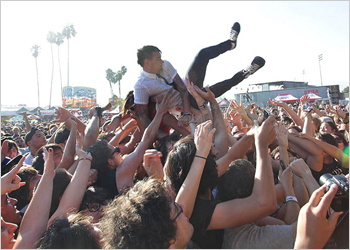
Now, there was a good reason why I asked the question “why,” and that reason was because whilst I stood in a poorly lit clothing store folding over priced and slightly trendy jeans, my friends where just a few miles away crowd surfing their way over thousands of screaming fans to the front Warped Tour’s center stage.
Pictured above: Not me
I hope that the agony in my being at this point has really hit home to you. If not, then you obviously need a lot more help than this article can do for you. However, if you do understand my pain, realize that it only increases from here for the following reasons: Firstly, I have never been to Warped Tour, and I’ve always wanted to go, for the obvious reason that I was in a band all throughout highschool. Secondly, that band that I was in, in highschool, was actually playing on a side stage at the very same time that I was folding these jeans.
I bet you are asking why the hell I wasn’t pumping my rock fist out there with my compadre’s right now. The answer to that question came from my parents the night before. “Because you have to grow up sometime,” they told me. What they meant was I needed to learn fiscal responsibility. What I heard was “Your life is over.” I really felt that way. I sat there folding jeans as the world of possibilities that I always envisioned was beginning to narrow.


This is fiscal responsibility kids. Take a good hard look. 
All I could think about at that point was a sitting at a table in my university’s cafeteria, advertising for one of the many events I put on. I genuinely believed that there was real value to attending a concert or dressing up in some ridiculous costume for a party. It brought people together, built community, it brought down the walls between the many clicks. But countless times, I would get a puzzled look and an immediate “maybe,” which, as we all know, means “no.” They would tell me how they had to study for some test they had coming up in the next few days, or write a paper that was due a week later. Sometimes it would be that they didn’t have the five dollars it would cost to participate. Sometimes, after suggesting that they borrow money, study instead of staying up late watching movies the night before, or requesting off work and trading with someone, they would inevitably say, “I just can’t.” They never even tried. Another thing that I noticed throughout the year was that it was always the same people that gave excuses as to why they couldn’t participate in college life, and more importantly, they where all completely and totally miserable, just like me and my overpriced jeans. I had become today what I hated most. I hadn’t just given up warped tour. I just plain gave up. I was no longer the kind of person that could do anything he wanted. Now that person had car payments and “fiscal responsibility.” My love of living went with my freedom out the window.
More often than not, this is what us Americans term, “Growing Up.”
“A man’s not a man until he pays taxes,” my Dad had said last night, as he attempted to talk me into sticking around the Fourth of July weekend and picking up extra shifts at work. I hadn’t even dared to tell him about Warped Tour, I could only imagine what his ‘fiscal responsibility’ would make of that bright thought. What he meant was that one becomes a man when he learns how to be responsible with his money. Car payments, phone bills, mortgages, not to mention insurance; in order to be an adult, one needs to keep these in the forefront of one’s mind, and apparently, that means sacrificing everything else in your life. We are all too familiar with the absent father, a pawn of a corporation that is more important to him than his family. He works long hours, goes on long business trips, and lives in the office. But that’s what it takes to feed the family right?

I’m quite familiar with this concept of “Growing Up.” I see it on the face of every freshman when he sees the first “C” he’s ever made. You see, freshman always come into school with spirit, full of idealism and ready to change the world. They participate in everything, they start new clubs, new sports, new fraternities and households, and then once they’ve over committed, they get their midterm grades back, and many of them inevitably have failed to budget their time wisely and where ill prepared for college by the public school system. All of the sudden reality comes crashing down around them, and their ideals vanish like the last bubbles of oxygen from drowning lungs. Now, the once bright young men and women, full of potential and dreams of change are welcomed with open arms into American Adulthood. They hole themselves up in the library, or in their dorm rooms, and no longer do they believe that they can have any effect on the world. No, it is all they can do just to pass their classes, graduate and get a job. They don’t even have the time to come to the occasional Open Mic Night.

The funny thing though, is that those same students that believe that they are having such a hard time passing their classes that they can’t get involved can be found on that very same evening, watching youtube videos at two in the morning with their friends. Those same students that say, “I don’t have five dollars,” will be found a couple days later buying an expensively fashionable cup of “free trade” coffee at the local coffee house. I’m starting to think that “Growing Up” should be substituted for “Giving In.”

I contemplated this as I took care to fold another pair of jeans so that the destroyed hem could be easily seen by the mindless consumer. I placed it on top of the eight inch pile and picked at it until all of the size stickers lined up perfectly. I was done. All of the jeans looked exactly the same. I exhaled a short unfulfilled sigh of completion, and looked up to see that all of my fellow workers wearing the same damned jeans that I just folded. I realized that they all looked exactly the same. They had the same hair, with just enough sidebang, all elegantly disheveled. They had the same grey v-neck t-shirts, with little variance in frayed lettering on the front. All of my coworkers, along with looking the same, shared something else in common. They where all students, working here so that they could go to college, so that they could get a corporate job, so that they could live in the same quaint little house, in the same quaint little suburb with a quaint little picket fence, and live for the quaint little weekends and Monday morning hangovers. Maybe C.S. Lewis was right to envision hell has a rainy suburb in which everyone was constantly moving farther away from each other. It was right then that I caught sight of myself, along with my breath, in the mirror. Today I had on a grey v-neck with elegantly disheveled sidebangs. I had on light jeans with holes at the knees, and I shared with my co-workers the same blank look that can only be worn by someone with nothing to live for. I almost broke down on the spot. I finished out my shift as anonymously as possible, and came home, went strait to my room, and cried my eyes out. Now that I was an Adult, with car payments and bills to worry about, I had little choice but to give in.

Maybe I was wrong. Maybe “Growing Up” really means sacrificing everything you’ve ever wanted, dreams and all. That night, I told my dad about everything that I was feeling, that I had sacrificed a concert, and not just a concert, but a dream, just so I could pick up a shift at work. He handed me a cold Sam Adams, and sat me down on the leather couches in the living room. He began by asking my forgiveness for not explaining himself better the night before. He had not intended to scare me into “Giving In.” He then proceeded to tell me how he had been a graduate school professor. He wanted to support his family, he wanted to send his kids to private school, he wanted to evangelize in a bigger way than his current job allowed him to do, so what did he do? He quit and started his own business with Wellness International Network. Now he’s got three kids in private Catholic University and his other two in Catholic school at home. We went as a family to Israel last Christmas on a pilgrimage he led, and we are going on a cruise together this summer. Most people could never dream of that kind of lifestyle, and that is precisely why they don’t have it. He ended with one short statement that I will always treasure as one of those defining moments where a father’s legacy is passed on to his son. He said:

“We do not live so that we can work, we work so that we might live.”

Life.
By live, I understood him to mean not just eating and drinking and having a roof over our heads. He meant LIVING, experiencing life, savoring it like you would savor a big juicy steak with your grandma’s mashed potatoes on the side. Living means making the sacrifices necessary to make your dreams come true, not sacrificing your dreams for a roof and a steady salary. You should never settle with forgoing life for existence. One of the most important lessons I learned from my father that night was that if you want something bad enough, you will make it work. Fiscal responsibility is not sacrificing your dreams so that you can exist, its not picking up a shift at work instead of going to the concert you’ve always wanted to attend. Fiscal Responsibility is drinking tap water instead of buying it bottled. Fiscal Responsibility is eating ramen noodles for a week strait. Fiscal Responsibility is going to freeking Warped Tour.

My Trip to Austen: Quidditch, Hang gliding, and Other Rash Behaviors. Part I

My Trip to Austen: Quidditch, Hang gliding, and Other Rash Behaviors. Part I


My adventure to Austen was SO awesome and so frikkin packed that I’m going to have to break it into three separate blog posts, which I will post this week (I swear).  Part one will focus on my time spent on the UT Quidditch fields.


            For those of you who have not heard, Quidditch, the magical broom riding sport of the Harry Potter world, has launched into muggle universities all over the US. My friend Augusta, who I was visiting this weekend, plays for the Gryffindor house at UT. Soon, her and her teammates will be traveling to the Quidditch world cup in New York. There will be something close to 40 college teams competing there from all over the world! Who knew right? Anyway, when I rolled into UT, Augusta and her roommate were already getting suited up for their Quidditch tournament against Slytherin, Ravenclaw, and Hufflepuff. I was very excited to even have the chance at witnessing such an event, but as we drove over to the field I was offered the opportunity of a lifetime: The chance to be the Snitch.

^ ME
GOOD HIT BRO!
Now let me explain for a moment how “Muggle Quidditch” as it has come to be known, is played. The players must hold a broom between their legs as the run around on the ground, attempting to throw a volleyball through three hoops at the end of the field. The snitch is actually played by a person dressed in gold, (usually a cross country runner or rugby player) who tucks a sack with a ball into the back of his shorts. The seekers attempt to pull said ball sack from the Snitches pants (no one ever jokes about this at all).  The thing that really makes this whole thing so awesome though, is that Snitches literally have no rules.
They can run wherever they want, do whatever they want, tackle, taunt, shove, and disrupt in whatever manner pleases them at any given moment. If you would like to see some premier seeker action from last year’s world cup in New York City, check this out:


For me, an ex cross country runner and rugby veteran, this was a dream come true! NO RULES? DO WHATEVER YOU WANT? TACKLE GUYS WHO CAN ONLY USE ONE ARM?
I think yes.
By the end of the night I had hid in two separate buildings, climbed over a barbed wire fence, hid on top of a roof, used innocent bystanders as human shields, disrupted a Frisbee game, a soccer game, and three separate tennis matches, tackled the crap out of the seekers, and thrown up a ham sandwich all over the field. It was pretty intense. But in the end, it really was a very joyful and outrageous experience.

This is a short clip that I think really captures the spirit of the game. Check it.


I’ve written about a few emerging games from the millennial generation, such as Humans verses Zombies and Assassins, and Quidditch really follows suit. It is a game that you can take super seriously, but will always, always be ridiculous. Childlike joy, my friends. That is what playing is all about. For those of you out there who would have never played or seen a Quidditch match, it is a thing worth adding to your bucket list. Look around online and I’m sure you’ll find a team or a tournament near you.

Here are some pictures of me snitching:


SO MUCH FUN!!!!

Fence Jumping!

About to throw up


YEEESSS!!!

SUCKIT GRIFFINDOR SEEKER!


Why I'm Moving to Holland

My friends, I know it has been a long time since I blogged. It is because I have been far too busy doing things worth blogging about. Things such as barhopping with a group of my Dutch colleagues and learning to curse in Finish. That was an entertaining episode, let me tell you what. Here are five reasons why I am moving to Holland in a couple years.

5. They are a very, very (hilariously) vulgar people.
My company “Wellness International Network” celebrated 19 years of success and expansion with a huge gala. A ton of people from Holland, Australia, and Turkey came over to celebrate. Let me tell you what kids, I am not an easy person to scandalize, but their descriptive offers of nights out on their red light district (prostitution) and their unabashed pride in their women’s bust size, was…. slightly embarrassing to my American sensibilities. They just don’t follow the same rules as Americans do, that is to say, you will scant find a dinner party in Holland in which religion and politics are not voraciously argued about with the use of delightfully colorful language. 

4. They are very, very passionate. 
Whilst keeping #5 in mind: One of our associates kids was playing a soccer game. Now, we all know that the Dutch love soccer. So obviously they all decided that they would go to the game. Keep in mind kids, that these kids are 13-14 and the only other spectators are their parents. Enter Jarno, an extraordinary man and business professional. He led the Dutch in their jeering and cheering, and when, by happenstance, our team’s goalie let a ball by –as eight graders often do—he curses profusely and yells for the coach to take him out. “TAKE HIM OUT TAKE HIM OUT!!!”
The woman next to him leans over and says “hey, that’s my son you’re talking about”
He turns to her, looks back, and continues to yell “TAKE HIM OUT!!!”
Then, when our team scored, all the Dutch yelled together: “HE HA HUNDULOO” or something like that. He told us it meant “Donky Dick.”  They yelled this at an 8th grade soccer game. 

3. They have conquered the ocean.
 Pictured above: Dutch imperialism. They've made their empire THE SEA
Half of their country is at least a hundred feet below sea level. If their dikes broke, their country would literally vanish. Whenever they need more space, you know what they do? Not build higher buildings! NO! They simply carve out more ocean. If that doesn’t say something about these people, I don’t know what does.

2. They do business like BAMFS. These people have taken health and wellness way past anything that most people in network marketing businesses could possibly imagine. Their training centers duplicate and account for millions of Euroes worth of business.
1. They are just frikkin hot. Fact.

Graduation Frustrations

So I’m sure many of you are very…. interested in hearing about my first experience working a nine to five job. Instead of telling this story several times over, I thought I’d just write it up on the ol’ blog.

            When I got home, I immediately (and by immediately, I mean after a week of straight Starcraft 2 ownage), I wrote up a kick ass resume for event planning. Then after running it by most trusted advisors, I threw that one away and made a new one.

Resume #1.

I sent it out to about 20 different event planning company’s and got three offers. Concerning those of you who are in collage or have not yet entered the work force, there are two words that you need to fear more than any other. Those words are “Internship” and “Entry Level.” If the former is slave labor, then the latter is “share cropping.” In other words, if you are in collage now or just graduating, you = this guy:


You are looking at either working for free, or if you are lucky, for $11 per hour. “But it’s good work experience,” you say “you have to be trained in your field!” I’ll refrain from pointing out the obvious pun.


Pictured Above: Valuable work experience.

So you are probably wondering if I was pouring coffee for free or for $14 an hour. The answer is neither. I lifting boxes in a warehouse which lacked air conditioning for somewhere in between “free” and “peanuts.” When all was said and done, had I worked for more than a week, I would have been making about enough to pay for the gas bill it took to make the hour and fifteen minute commute into Fort Worth. If you are bad at math, I’ll help you out. $0 = not enough to move out of my house.


The College Graduate’s future bedroom.

“Well even if you are driving two and a half hours a day to do manual labor in a warehouse without air conditioning and living at your parents house, it’s just a stepping stone, right? The career of your dreams is probably waiting for you somewhere on the other side of the rainbow!”  OR IS IT MY OPTIMISTIC FRIEND? HOW MUCH DO YOU LIKE YOUR BOSS!

Yeah...

Ehm. Sorry. I got a little carried away there. But seriously, how many of you really wanted to have a boss when you were five years old? My ideal career is one in which I am the boss. Would you agree? But there is always a “but,” here it comes….
 “But Marcellino, it’s time to grow up and face reality, everyone has to work for a boss.”
Mr. Strawman sir, I have a question for you. Where did your job come from? What I mean is, someone somewhere actually owns the business you work at. Someone somewhere signed the lease on your office building, hired your boss’s boss, and right now is probably sailing his yacht to the Bahamas.

With a Tennis Court

So no, not everyone has a boss. But anyway, back to my story. I worked at Bella Events for a boss named Bambi and her husband who everyone called “Hefe.” I was employed for one week total. After working in the warehouse alongside several 200 lb, six foot tall blue collar type guys, I was moved into the office to train under Tiff, a cute sorority girl with about as much personality as a rock. She had absolutely no interest in training me, as that would take some effort, so I sat in the office watching her do work for two days strait.


Commence Twiddling!

Third day roles around and Tiff is nowhere to be found. She up and quit, leaving me totally untrained. Hefe, the boss man, brings me into his office as soon has he gets in, sits me down, and drops the following pile of bullshit: “From what I’ve heard, Marcellino, it’s not looking so good for you. Everyone says that you just aren’t doing anything, that you are too laid back, just lounging around. If a racehorse is gonna run, he’s gonna run.”

Indeed.

I told him what I thought about that statement in the most tactful voice possible. Of course I didn’t look like I was working! You told me to sit down and watch Tiff do her thing. Either way, Tiff was gone. This meant that I was now actually being trained by Maggi, the woman in charge of rentals. I really started to learn, and by the end of the day, I thought I had a pretty good handle on it all. That was on Wednesday. On Thursday, I came in and worked my ass off. I was slow, but I was getting it. I was asking five million questions every five minutes, taking notes, and now I didn’t really even need Maggi. I was on a role. Friday came around, and I finished all of the work that needed to be done and hour and a half early. Keep in mind, my friends, that Hefe and Bambi were both around all week long. Here comes the kicker. Turns out, Bambi had sent me an email on Wednesday afternoon letting me know that I was fired. I forgot to check my email until Saturday. I worked two days after I was already fired, and NO ONE SAID A DAMNED THING.


My Last (Senior) Will and Testement

Last (Senior) Will and Testament
of
Marcellino D’Ambrosio


I, Marcellino D’Ambrosio, resident of Sebastian Hall at Ave Maria University, being of sound mind and disposing memory and not acting under duress or undue influence of alcohol, and fully understanding the nature and extent of all my property and of this disposition thereof, do hereby make, publish, and declare this document to be my Last (Senior) Will and Testament, and do hereby revoke any and all other wills and codicils heretofore made by me.
FIRST:
a.       I direct that all my debts, fines, minor infractions, major infractions, and other said debts as soon after my death as may be reasonably expected, be passed on to my Personal Representative and Executor Michael Foose.
b.       I hereby authorize Executor Foose hereinafter appointed, to settle and discharge, in his absolute discretion, any claims made against my estate. (Have fun buddy!)
SECOND:
a.       The entire residue of the property owned by me at my death, real and personal and wherever situate, I devise and bequeath to my Trustees appointed by this document:
THIRD:
a.       To our good friend Colin Brown I do bequeath all the unmitigated hatred and disrepute I have accumulated over the past four years. I have heard that a bit of good old fashioned hatred is good for the digestive track.

b.      I do herefore pass on the good deed of the week trey and all traditions accompanying the Mc Don Don Fraternity to David Hallenback for their safe keeping and propagation.
I leave Chocolate Milk Pong and “Duces” to Kevin Doran. I leave all of my research of the health benefits of the McDonalds diet to Mathew Prokop. May the eternal blessings of the Golden Arches be with you.

c.       To John Jochum I bequeath my Iron, which you’ve had all year anyway, as well as a portrait of my moon, and a six pack of corona. HAGS!

d.      I bequeath to Caleb Mathew Anthony Glaser all of the “Pizza” that is not consumed during the I.A. ritual. (See Sixth).

e.        To Kelson Thomas I leave my stash of cocain. Don’t worry dude, I already put it in your closet with the rest of your weed.

f.        To Travis Spier, Colby Popik, David Halenback, Kevin Doran, Matthew Prokop, Charlie Carlisi, Sean Gill, and Brian McBride, A.J Fleschniman, I leave Sebastian Hall, her pride, her traditions, her memories, her stories, and her life. Let her spirit live on!

g.       I leave my babies: Dorm Wars, Swampfest, and the propagation of the SAB to Jaleh Jerami. I know I leave them in capable hands. I mean hand. Ehm.

h.       To Kevin McCaffrey I bequeath all of my discontent caused by senioritis. Good luck buddy!

i.         I leave the caretaking of the Frisbeterians to Shawn Scanlan. Rock’n Roll Bruv.

FOURTH:
If any beneficiary under this Will, or any trust herein mentioned, contests or attacks this Will or any of its provisions, any share or interest in my estate given to that contesting beneficiary under this Will is revoked and shall be disposed of in the same manner provided herein as if that contesting beneficiary had predeceased me.
FIFTH:
My Personal Representative shall elect under Section 2056(b)(7) of the Internal Revenue Code of 1954, as amended in the Student Handbook, or other similar statute then in force, to qualify the Household Trust that all those graduating are exempt from all cleaning checkout requirements ie. sweeping, mopping, dusting. These tasks pass to those designated household members not graduating: Nathan Gutman, Charlie Carlisi, Michael Santschi, and Daniel Sadasivan.
SIXTH:
Upon my graduation, it is my wish that my body and essence undergo the rites of Intoxication and Alcoholization (IA). To that end, I specifically direct the following:

1.      The rites of I.A will be conducted by PBR (Pabst Blue Ribbon), a 501(c)(3) organization. Upon my death, I donate my body to PBR for the purpose of conducting said rites.

2.      My body shall be delivered as soon after my graduation as practicable and to the full extent legally possible, without any sharpie writing on the forehead, to any bench, ditch, or bed, by PBR with my shoes still on.

3.      The above said bed so designated by PBR shall be henceforth purged upon awakening the next morning. All so called texts, calls, email messages, facebook comments and the like made during the rights of I.A. shall be excused under Article Ten bylaw 14a of the Student Handbook under “Graduation.”

I have made pre-arrangements with PBR for my I.A.. Because the rights of I.A. are very elaborate, detailed, thorough, and lengthy, I have pre-arranged a donation of the total sum of twenty six dollars and 87 cents (27.89), as gathered in my junk draws, to PBR which will assist the organization and carrying out my wishes.
SEVENTH:
I hereby name Nathan Gutman my Designated Driver, Prudent Friend, and Attorney for the duration of my Intoxication and Alcoholization rights, as well as for the spreading and propagating of my reputation hereafter. This includes any: building of statues in my honor, any future pouring of libations, the embellishment of all stories of my deeds, and epic poems written in my honor.
Any clarifications or instructions concerning this Will may be obtained by calling the above-mentioned attorney who is requested to do everything necessary to implement the provisions of this Will.

IN WITNESS WHEREOF, I, Marcellino D’Ambrosio the testator/testatrix, sign my name to this instrument consisting of pages this 29th day of April, 2011, and being first duly sworn, do hereby declare to the undersigned authority that I sign and execute this instrument as my Last Will and that I sign it willingly (or willingly direct another to sign for me), that I execute it as my free and voluntary act for the purposes expressed in it, and that I an 18 years of age or older, of sound mind, and under no constraint or undue influence.

Testator/Testatrix
Marcellino D’Ambrosio


We, Luke S. Walker  and  Hans Olo, the witnesses, sign our names to this instrument, being first duly sworn, and do hereby declare to the undersigned authority that the testator/testatrix declares it to be his/her Last will and requested us to sign as witnesses thereof, and that he/she signs it willingly (or willingly directs another to sign for him/her), and that each of us, in the presence and hearing of the testator/testatrix and of each other, hereby signs this will as witness to the testator's/testatrix’s signing, and that to the best of our knowledge the testator/testatrix is 18 years of age or older, of sound mind, and under no constraint or under influence.


Notary Public:                                                                       Date:
            Jennifer Snow                                                                                     April 29th, 2011 


Why I Don't Like Jane Austen

I was assigned to write on the two endings of Persuasion, but I couldn't bring myself to write a single page. Why? Because *gasp* I don't like Jane Austen.

To be honest, that's not entirely true. If Jane Austen was alive today, I would probably fall head over heals in love with her simply because of her wit. I then would find that she had me pinned from the beginning and that I was never good enough for her.... and before you know it I would be laying on my couch at four in the mourning eating cookie dough from a carton and sobbing hysterically while "Sleepless in Seattle" plays in the background.

"I'll never" *sob* "be" *sob* good enough for her!" *sniffle*


Ok. So maybe its best if she stays in the Victorian England. Ether way, I'm about to do something that I've never, ever, ever done before. I'm about to disagree with Clive Staples Lewis. I never thought it would happen, but it did. Here we go.

Bigness in Jane Austen
Marcellino D'Ambrosio
Dr. Curtright
4/28/11

"Miss Austen understood the smallness of life to perfection.”
–Lord Alfred Tennyson

            Austen may understand the smallness of life to perfection, but she does not perfectly capture life, because for her, life has no bigness at all. For Austen, life is wholly and purposefully absent of the extraordinary. C.S Lewis writes in his “A Note on Austen” that “She is no Utopian.” I find this claim to be a radical understatement. Austen moves and breaths in a nineteenth century English universe that is at once morally and socially rigid. Austen, who follows Johnson, has far more in common with her deistic and empirical contemporaries than with any Christian writer. Johnson and Austen’s god is a distant one, who creates a depraved human being and leaves him to his own devices in a boorish, mundane world. Austen’s novels are not simply “not Utopian,” they are truly pessimistic accounts of small minds with even smaller lives—the smallest of whom are her heroes.
            Johnson begins his Rambler No. 4 with the following quotation: “The works of fiction… are such as exhibit life in its true state, diversified only by accidents that daily happen in the world, and influenced by passions and qualities which are really to be found in conversing with mankind.[i] For Johnson, the novel is concerned with the mimesis of reality, and thus selects for its subject matter the daily occurrences and conversations of every day life. Johnson continues, condemning the fairy tale and “heroic romance” as artificial entertainment meant to excite the idle mind. He writes: “it is therefore precluded from the machines and expedients of the heroic romance, and can neither employ giants to snatch away a lady from the nuptial rites, nor knights to bring her back from captivity; it can neither bewilder its personages in deserts, nor lodge them in imaginary castles” (155). The task of the author is to provide a moral education through the “normal.”  Austen takes this advice to heart, and selects the most normal of people for her subject matter, and places them only in the most normal of circumstances. She does this so that the “normal,” “small,” “average,” fellow might recognize his own life contained in between the pages of her novels.
            To be sure, Austen masterfully captures these characters as they interact with each other. She does so with simplicity, subtlety, and a supreme wit that cannot be replicated. There is something admirable in packing a particular moment in life with power and meaning. Austen indeed does this well in her scene where Mr. Nightly meets Jane Fairfax on her way to mail a letter. Their conversation is the surface to a sea of depth. Only Austen can capture such a moment with such subtlety. I take issue not with “the small” as her proper subject matter, but with Austen’s use, and not only use of, but limit to, the “normal.”   
            Austen limits herself to the normal, or the ordinary, and in doing so, eliminates all possibility for the extraordinary. When Austen removes the nights and castles and giants of the fairy tale from her works, I say: “fair enough Ms. Austin, fair enough;” far be it from me to tell an author what she can and cannot select to mimetically represent in her fiction. Fairy tale castles and 19th century estates can be just as effective, as long as she honestly captures the human experience. Austen, however, does not stop with throwing out the nights and castles and giants. C.S Lewis writes of Austen’s world: “Elinor felt sure that if Marianne’s new composure were based on ‘serious reflection’ it ‘must eventually lead her to contentment and cheerfulness’. That it might lead instead to a hair-shirt or a hermitage or a pillar in the Thebaid is not in Jane Austen’s mind.”[ii] To be sure, more often than not, the ordinary person would not end up on a pillar in the Thebaid. The issue is that there are people who would. As I said previously, it is not necessary for an author to write about those people that are extraordinary. I do not accuse Austen of simply poor choice in subject matter. The problem is that she purposely excludes the possibility of the extraordinary from characters and circumstances both. The process goes like this: “Why doesn’t Marianne run off, go on a journey of the soul that leads her halfway across the world? Well, obviously because normal people don’t do that, that’s too much like a fairy tale. She should be perfectly content to stay and marry Colonel Brandon.” But normal people, when placed in extraordinary circumstances, sometimes do extraordinary things, and so become extraordinary. That possibility is entirely cut off from Austen’s characters in order to preserve “normality.”
             I would venture to make the claim—however outrageous it may seem—that most “normal” human beings, whatever the age, do not live meaningful lives—or meaningful stories for that matter. That is where the term “extraordinary” gets its positive connotations. Most human beings themselves are dull, so when an author limits himself to “normal” people and “normal” circumstances, he must not be surprised when he finds himself steeped in the insipid.
            That is precisely my quarrel with Austen. For all her dynamic narration and characterization, she limits her world to dull and insipid characters and disallows for any possibility of extraordinary change. Her hero’s demonstrate this insipidity magnificently. Edward Ferrars and Mr. Darcy are very week characters, and as real men in a real world, would garner little respect from anyone around them. They are hardly the type of men whose grandchildren will still be telling stories about them ten years after their epithets have been inscribed on their grave stones. In short, they would be all but ignored. For instance, Edward Ferrars, as a character is hailed for his dutiful and loyal nature. He refuses to break off an old engagement to Lucy Steele, even with complete knowledge of what a manipulative man hunter she is. Dogs, however, are loyal and dutiful. Men are leaders. When Austen describes Edward Ferrars, she does little to justify why any woman would find him attractive. She writes:
“Edward Ferrars was not recommended to their good opinion by any peculiar graces of person or address. He was not handsome, and his manners required intimacy to make them pleasing. He was too diffident to do justice to himself; but when his natural shyness was overcome, his behaviour gave every indication of an open, affectionate heart. His understanding was good, and his education had given it solid improvement. But he was neither fitted by abilities nor disposition to answer the wishes of his mother and sister, who longed to see him distinguished—as—they hardly knew what. They wanted him to make a fine figure in the world in some manner or other. His mother wished to interest him in political concerns, to get him into parliament, or to see him connected with some of the great men of the day. Mrs. John Dashwood wished it likewise; but in the mean while, till one of these superior blessings could be attained, it would have quieted her ambition to see him driving a barouche. But Edward had no turn for great men or barouches. All his wishes centered in domestic comfort and the quiet of private life.” (italics added).

Edward is the preeminent domesticated man. Granted, his mothers wishes to see him “distinguished” are sardonically superficial. But is the public realm itself superficial? Only if there is no work to be done. If all problems in the world have been solved, or if they are beyond solving, public action has no worth. But at the time that Edward Ferrars is seeking the quiet of a “private life,” Napoleon is conquering half the known world and bringing with him the ideals of the French revolution. The real world outside of Austen’s quiet domestic universe is falling to pieces, but Edward wants no part of that, all he wants is “domestic comfort.” “Where is his sense of duty to humanity” I ask, “Where is his loyalty to England and posterity?” There is no force, no thumos, or manly vigor, to his character at all. The only construct that holds him together and keeps him from running through our fingers like so much water is “duty,” as dictated by 19th century English society.
            It is not the selection of Edward as a character that I quarrel with. I just cannot believe that any woman would desire him as a husband. He is set up as someone worthy of imitation, as if it is a good thing that Edward has no passion or zeal for the world. That is a mimetic problem as well as an aesthetical one. Austen hardly captures the really real in that character. Yet, he is held up as almost the best that “normal” can give. The very best of normal is found in Mr. Darcy.
            None of Austen’s heroes have any vocational calling or public aspiration outside of the heroin’s respective social circle, not even the illustrious Mr. Darcy. At the start of Pride and Prejudice, Darcy is well satisfied with himself and his own status. He lives as any member of the wealthy class could afford to live. He reads in his well stocked library, goes riding on the countryside, and detests dancing with such rabble as Lizzy Bennet. [iii] Thankfully, by the end of the novel, Lizzie has cured him of his distaste for dancing. However, I cannot yet find a reason for her to marry him other than the fact that he is the best that the narration has to offer. Of course, when compared with Bingly, Collins, and Wickham, Darcy is the spitting image of manly virtue and learning, but the world he inhabits is so very, very small. Surly there are other men in England that would marry Lizzy who are at once wealthy, intelligent, and have all the dreams and desires and spirit that make the human being so dynamic and interesting? That option is not left open for Lizzy. For her, Darcy is the only intelligent male in a six man world of imbeciles. Simply put, it is Austen’s narrative ability that makes Mr. Darcy and Edward Ferrars attractive, and only by comparison to the absolute dregs of boorishness. The attraction over Austen’s readership does not spring forth from any energy within them selves, Edward least of all. Yet, it is true, men such as this often do marry, just as it is true that women often settle for such men.
            Lewis writes of this very subject that “In real life, no doubt, we continue to respect interesting women despite the preposterous men they sometimes marry. But in fiction it is usually fatal” (Lewis.182). Of course we may still love a woman who marries a preposterous ignoramus the same way we may love a friend who borrowed your car and returned it without a front bumper. Mistakes may be forgiven. Lewis recognizes that in fiction, however, the failure to select a worthy spouse is a death sentence. For Austen, too it seems selecting a spouse is at once a moral and human imperative. Poor selection is indicative of a failure in character analysis. Mr. Bennet remarks of Charlotte Lucas’ dubious choice in Mr. Collins: “it gratified him, he said, to discover that Charlotte Lucas, whom he had been used to think tolerably sensible, was as foolish as his wife, and more foolish than his daughter!” (Pride and Prejudice.23). I level the same accusation against Elizabeth. A truly sensible and witty woman would not be easily attracted to a man as docile as Edward or as priggish as Darcy, and a marriage to such a one would seem like a failure in judgement.
             Mr. Bennet’s own marriage to the endlessly prattling Mrs. Bennet is the marriage of two unequal minds, which are mixed with disastrous result. Austen narrates in Pride and Prejudice: “To his wife he was very little otherwise indebted, than as her ignorance and folly had contributed to his amusement” (195). Mr. Bennet’s marriage is not a happy one due to the inquality of mind. Lizzy and Darcy my be equal in their  reasoning capacities, but they are not in any way equal in character. One could hardly see Mr. Darcy walking miles through the mud, jumping in puddles and rejoicing in creation, as Elizabeth might. Nor would he playfully scorn an indignant blue blooded lady for his own amusement, as Elizabeth might. To be quite honest, one could hardly see Mr. Darcy playing at anything at all (for it would hardly be “becoming" of a 19th century man to do so). Elizabeth is a creature of wit, not simply of reason, and Darcy in no way measures up to her playful spirit.
            Yet Darcy’s marriage to Elizabeth is the paragon of “attatchment” for Austen. If any of her characters was extraordinary, it was Lizzy, and yet she settles for a man who is just a mind with a checkbook. Whats more, that match is glorified. That is not mimesis of reality. It might happen in reality, but the truth of the matter is that there very well could have been another hero that would have suited Lizzy better, and reality is much, much bigger than Netherfield Park. Darcy is only a hero, then, in that he is the man the heroin selects to be her mate, and that is no true measure for a hero.
            No, a true hero is great, in real life as well as in prose.  It is true that Darcy is charitable, in a way. After all, he does pay off Wickham so that he will marry Lydia and spare the Bennet family the shame of such an elopement (269). But it is a relatively small sacrifice that Darcy makes, and will not affect his lifestyle. However, good stories as well as good lives are forged of great and total sacrifices as well as from small ones. Lewis writes that Austen “could almost have said with Johnson, ‘Nothing is too little for so little a creature as man’. If she envisages few great sacrifices, she also envisages no grandiose schemes of joy” (186). He calls this “cheerful moderation.” I call it boring; as boring as the mediocre life of the modern man.
            Lewis himself recognizes the limits of Austen’s world as he affirms her in limiting it: “There is just a hint in Persuasion that total sacrifice may be demanded of sailors on active service; as there is also a hint of women who must love when life or when hope is gone. But we are then at the frontier of Jane Austen’s world” (186). The slightest hint of total sacrifice is the very “frontier” of Austen’s world! Tragic struggle, heroic self gift, and magnificent joy, all elements of the Christian life are eliminated, thrown out along with the castles, knights and dragons, as if they are similarly impossible. These are impossibilities only to an author who does not believe in a God that acts within creation. Greatness is no vain desire with the presence of grace, and nether is the miraculous. Only the pessimist recoils in fear at the slightest human passion. Only the pessimist cries out (only as loudly as is prudent, of course) “Enjoy that ball, enjoy that ride, enjoy that stroll because that’s as good as it will ever get!” That sucks the stargazing of all it wonder. It casts a damper on it all. So why, then, is Austen dubbed “a comic” writer?
            Lewis is of the opinion that Austen is a "comic" author, because a tragic author demands everything from his characters while Austen demands very little. She is “unexacting in so far as the duties commanded are not quixotic or heroic, and obedience to them will not be very difficult to properly brought up people in ordinary circumstances” (186). Whether or not “quixotic” virtue ought to be a good thing or not is a topic for another conversation. What can be said, however, that it would not be amiss, unrealistic, or even “quixotic” to ask Edmund for a backbone or Darcy for some passion outside of his relationship with Lizzy. Realistically, greater men, men that are indefinable by social convention, extraordinary men are the only ones deserving of Lizzy Bennet, Emma Woodhouse, and Anne Elliot. Around men such as those, the fairy tale creeps back into the ordinary. Real romance, passion, and fiery life, all anathema to the English moralist, find their way into the daily and the ordinary. A man deserving of Lizzy Bennet would re-define the normal. What would such a hero look like? You might get close if you gave Edmund Bertram Henry’s charm. You might get closer if you gave Wickham Darcey’s good nature; and if Willoughby had married Mary Anne, now that would have been something special, something great, something extraordinary.


[i] Samuel Johnson, The Rambler No. 4, in “Samuel Johnson Selected Poetry and Prose,” ed Frank Brady and W.K. Wimsatt, (Los Angeles, University Press: 1977) 155. Hereafter cited internally.
[ii] Lewis. 185 Hereafter cited internally.
[iii] Jane Austen, Pride and Prejudice, (Konemann Press, Hungary: 1996), 14. Hereafter cited internally.